

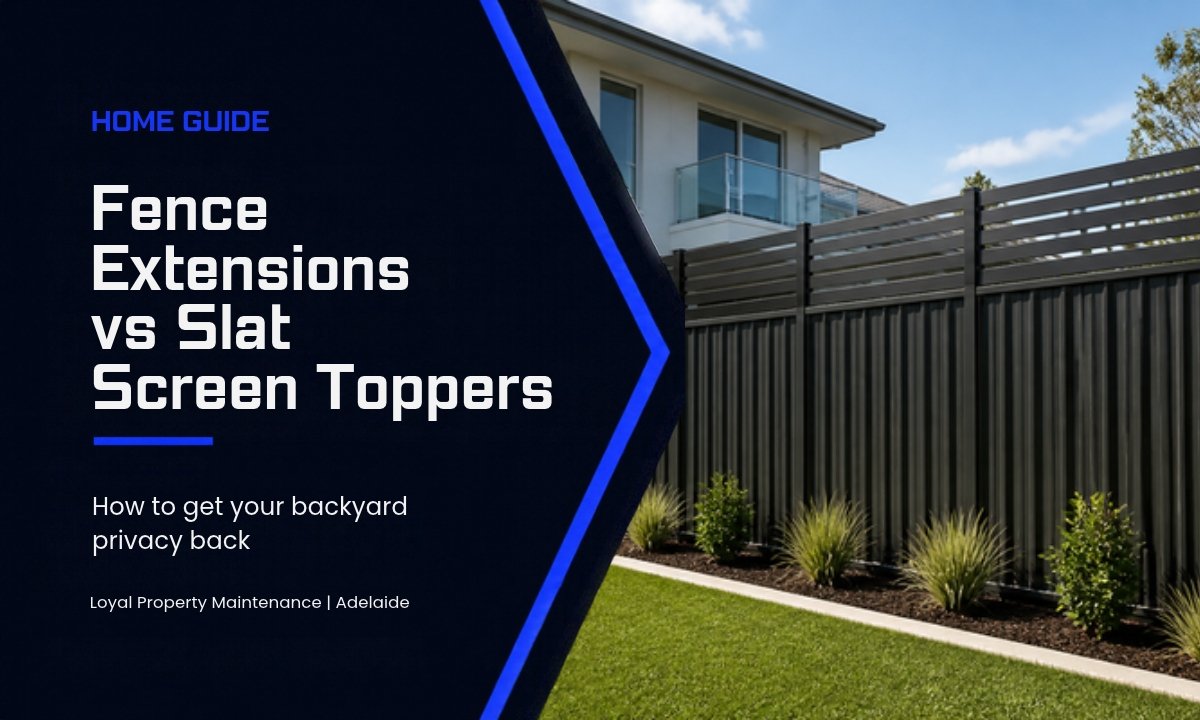
Fence Extensions vs Slat Screen Toppers: How to Get Your Backyard Privacy Back
Posted on November 12, 2026
It usually starts with a new double-storey going up next door. One week you’re having a coffee on the back step in your trackies, and the next there’s a big upstairs window looking straight down into your yard. Nobody’s done anything wrong. It just doesn’t feel like your backyard anymore.
Or maybe it’s the neighbour’s kids on the trampoline popping up over the fence every three seconds. Or a dog that’s worked out it can clear 1.8 metres if it really tries.
Whatever it is, the fix is usually the same: add some height. The two most common ways to do that are a Colorbond fence extension or an aluminium slat screen topper. They both work, but they’re not the same thing, and picking the wrong one is how people end up with a yard that feels like a prison yard, or a screen that still lets the neighbours see in.
Here’s how to settle the fence extension vs slat screen topper question for your yard, without the sales pitch.
The Short Answer
- Want it blocked out completely, matching your existing fence, on a tighter budget? A Colorbond fence extension is usually the go.
- Want privacy but still want light, a breeze and something that looks a bit more modern? An aluminium slat screen topper is probably the better fit.
- Only bothered by one window or one corner? You might not need either along the whole fence. More on that below, because it can save you a fair bit.
Option 1: Colorbond Fence Extensions
A Colorbond fence extension is pretty much what it sounds like. Brackets or extended posts are fixed to your existing fence posts, and an extra panel of Colorbond sheeting goes on top. Extensions commonly add somewhere between 300mm and 600mm, depending on the kit and how much height you need.
Because it’s the same material as the fence below, it looks like one taller fence rather than a fence with something stuck on top. Most of the standard Colorbond colours are available, so you can match Monument, Woodland Grey, Surfmist or whatever you’ve already got.
What’s good about them
- Complete privacy. Nobody’s seeing through solid steel.
- They look tidy when matched to the existing fence.
- They’re generally the more budget-friendly way to add height along a long run.
- Close to zero maintenance, same as the fence underneath.
What to think about
- They block light. If your garden beds run along that fence, they’ll get more shade, especially on the northern side of your yard.
- They block the breeze. On a hot Adelaide arvo, that’s not nothing.
- A taller solid fence catches a lot more wind. That puts extra load on posts that were only ever designed for the original height (we’ll come back to this, because it matters).
- A long run of 2.4 metre steel can feel a bit closed in, especially in a smaller yard.
Option 2: Aluminium Slat Screen Toppers
A slat screen topper is a row of horizontal aluminium slats fixed above your fence line. Depending on the fence and how much height you want, it’s either mounted to extended posts on the existing fence or to its own posts set just inside your boundary.
The gaps between the slats are the clever bit. With a narrow gap, you get strong privacy when someone’s looking straight at it, but light and air still get through. People sometimes call these slat privacy screens or fence privacy screens, and they’re one of the most popular ways to add privacy without making the yard feel boxed in.
What’s good about them
- Light and airflow still come through, so your plants and your outdoor area don’t go dark.
- Less wind load than a solid panel, which is kinder to your fence posts.
- They look more like a design feature than a fix. A lot of people end up liking the screen more than the fence.
- Aluminium doesn’t rot, warp or need oiling. Powder-coated finishes hold up well in our sun.
What to think about
- They’re not 100% see-through-proof. From some angles, especially looking down from a second storey, you can see between slats. Tighter gaps help.
- They usually cost more per metre than a basic Colorbond extension.
- Getting slats perfectly level and evenly spaced takes care. A sloppy install is really noticeable.
What about timber slat screens?
Timber looks great when it’s new, and it’s a popular choice. The catch is upkeep. It needs oiling or staining every year or two, and in full sun it’ll grey, cup and move. If you love the timber look and don’t mind the maintenance, go for it. If you just want it done and forgotten, aluminium is the safer bet.
Fence Extension vs Slat Screen Topper: Side by Side
| Feature | Colorbond fence extension | Aluminium slat screen topper |
|---|---|---|
| Privacy | Complete | Strong, depending on slat gap |
| Light and breeze | Blocks both | Lets both through |
| Wind load on fence | Higher | Lower |
| Look | Taller version of your fence | Modern, feature-style screen |
| Maintenance | Minimal | Minimal |
| Cost per metre | Usually lower | Usually higher |
| Best for | Long runs, total blocking, tight budgets | Alfresco areas, gardens, smaller yards |
The Bit Everyone Forgets: Can Your Fence Actually Take It?
This is the part that catches people out. Your existing posts were designed and footed for the fence’s original height. Add 600mm of solid steel on top and the posts are now dealing with a lot more wind pushing on them.
On a newer fence with solid steel posts set properly in concrete, that’s usually fine. On a 25-year-old fence with posts that have already started to rust or rot at ground level, it can be the thing that finally tips them over in the next big winter storm. Then you’re paying for a new fence and the extension.
Before anything goes on top, someone should check:
- Whether the posts are solid at ground level (give them a push, then look at the base)
- How deep and how sound the footings are
- Whether the fence is already leaning anywhere
If a few posts are tired, it’s much cheaper to replace them first than to deal with the fallout later. That’s one reason slat screens on their own posts are popular on older fences: the new screen doesn’t lean on the old fence at all.
Adelaide Privacy Screening
Not sure your fence can take the extra height?
Lee checks your posts and footings, works out where the privacy actually needs to be, and quotes the extension or slat screen that suits your yard.
- 35+ years in the trade
- Licensed BLD 282422
- Free quotes
Height Rules and Your Neighbours (the SA Bits)
A quick heads-up before you get too attached to a 2.7 metre wall of privacy.
Height
The SA Government advises checking with your local council if a fence will be higher than 2 metres, or if a masonry fence will be higher than 1 metre. A standard 1.8 metre fence with a 600mm extension takes you to 2.4 metres, so it’s worth a quick call or a look at your council’s website before you commit. Councils can also have rules for corner blocks and front fences.
Your neighbour
A dividing fence belongs to both of you. Under South Australia’s Fences Act, if you want your neighbour to chip in for fencing work, you need to give them proper written notice, and they have 30 days to respond. Most people adding privacy just pay for it themselves, but you’ll still want your neighbour on board before anything gets bolted to a shared fence.
Honestly, the conversation usually goes better than you’d think. Plenty of neighbours are just as keen on the privacy as you are. Going over with a photo of the screen you’re planning goes a long way.
Mounting it on your side
If the conversation isn’t going anywhere, a slat screen on its own posts set entirely inside your boundary avoids touching the shared fence altogether. It’s your screen, on your land.
You Might Not Need the Whole Fence
This is where you can save a good chunk of money. Before you quote the full run, go and stand where you actually sit. Your alfresco, your back step, the spot where the kids play. Then look at what you can see, and what can see you.
Nine times out of ten, the problem is one window or one stretch of a few metres, not the whole boundary. Some options:
- Screen just the section that matters. Three or four metres of slat screen opposite the neighbour’s window often does the whole job.
- A freestanding screen near your entertaining area. Instead of making the boundary taller, put a privacy screen closer to where you sit. Because it’s closer to you, a shorter screen blocks more of the view.
- Mix and match. A Colorbond extension along the side where you just want it blocked, and a slat screen near the alfresco where you want it to look nice.
Picking Colours and Slat Gaps
A few things that make the finished job look intentional rather than tacked on:
- Match or contrast on purpose. Matching the fence colour (say Monument on Monument) makes a screen disappear into the fence. A contrasting finish like a timber-look aluminium turns it into a feature. Halfway between usually looks like a mistake.
- Gap size is a trade-off. Smaller gaps mean more privacy and less breeze. Common gaps run from about 5mm to 20mm. If someone’s looking down from a second storey, go tighter.
- Slats run horizontal for a reason. Horizontal slats make a space feel wider and suit most modern Aussie homes. Vertical can work too, but it reads differently.
- Think about the neighbour’s side. Most decent screens look finished on both sides. It’s a nice touch, and it makes that neighbour conversation easier too.
A Few Real-World Examples
The new double-storey
Older single-storey home, brand-new two-storey next door with a master bedroom window facing the backyard. A slat screen with tight gaps on its own posts, opposite the window only, so the old fence doesn’t take any extra load and the rest of the yard stays open.
The dog that can jump
Solid, newer Colorbond fence, kelpie cross who’s figured out the top rail. A matching 300mm Colorbond extension along the side he jumps. Cheap, quick and invisible to the eye.
The small courtyard
A unit with a tiny courtyard where a solid wall would make it feel like a cell. Aluminium slats in a lighter colour, which add privacy while keeping the light, and actually make the space feel bigger.
Common Questions
Are Colorbond fence toppers the same as extensions?
People use the names for the same thing. "Topper" sometimes means a lattice-style or decorative strip, while "extension" usually means a solid infill panel. Either way, it sits on top of the existing fence to add height.
How much height can I add?
Most extension kits add 300mm to 600mm. The practical limit is usually your posts and your council’s height rules, not the product. In SA, check with your council if the total height will go over 2 metres.
Will a slat screen give me full privacy?
From straight on, a well-installed screen with a narrow gap gets very close. From a high angle, like a second-storey window, you’ll see a bit more between the slats. If that’s your problem, ask for tighter gaps or a slightly taller screen.
Can I put a privacy screen on my side without changing the shared fence?
Yes. A slat screen on its own posts, set just inside your boundary, doesn’t touch the dividing fence at all. It’s a good option for older fences, or when you’d rather not involve the neighbour.
What’s better for a garden: Colorbond or slats?
Slats, almost every time. Plants along a fence need light, and a solid extension can throw a lot more shade, especially on the northern side of your yard.
Can an extension go on an old fence?
Sometimes. It depends entirely on the posts. If they’re rusting or rotting at the base, fix those first or the extra height can push them over in the first big wind.
Is aluminium better than timber for a slat screen?
For most people, yes, purely on maintenance. Timber looks lovely but needs regular oiling or staining in the Australian sun. Aluminium just needs the odd hose down.
Not Sure Which Way to Go?
That’s normal. Most people know the problem (“I can see straight into their kitchen and they can see straight into my yard”) but not the fix. It’s easier to work out standing in the backyard than on a screen.
Lee has been in the building trade for more than 35 years and holds licence BLD 282422. He’ll come out, check whether your posts can take the extra height, look at where the privacy actually needs to be, and give you a straight answer on the extension vs slats question. Sometimes that answer is “you only need four metres of it”.
Have a look at our aluminium slat screening installation service. If the fence underneath needs work first, our fence and gate repairs in Adelaide cover posts, panels and footings.
Or just give Lee a call on 0431 740 780 for a free quote. Send through a couple of photos of the fence and the view you’re trying to block, and he can usually give you a rough idea before he even comes out.